Learning a few essential Arabic business phrases can help you build stronger professional relationships in the Gulf. Greetings such as as-salāmu ʿalaykum (peace be upon you), polite expressions like shukran (thank you), and common courtesies such as in shāʾ Allāh (God willing) are useful in everyday workplace interactions. Even when business is conducted primarily in English, understanding these expressions can help you communicate more respectfully, participate more confidently in conversations, and avoid cultural misunderstandings.
As an Arabic teacher, I encourage my professional students to pay attention to the meaning behind these expressions. A greeting can establish warmth, a particular form of address can communicate respect, and a familiar phrase may carry a different implication depending on the situation. Understanding these details helps learners communicate more naturally and avoid misunderstandings that a literal translation might create.
In this guide, I’ll introduce some of the most useful Arabic business phrases, explain how they’re used across different Gulf settings, and share the approach I recommend for professionals preparing to work or build business relationships in the region. We’ll also look at the differences between formal and spoken Arabic, so you can begin learning expressions that suit your destination and the people you’ll be communicating with.
→Sign Up Now: Free Trial Arabic Lesson With a Native Teacher!←
Why Arabic Matters for Business in the Gulf
In countries such as the United Arab Emirates, Saudi Arabia, Qatar, Kuwait, Bahrain, and Oman, Arabic plays an important role in professional relationships, government interactions, and everyday communication, even though English is widely used in many international workplaces.
If you’re joining a multinational company in Dubai, meetings and everyday office communication may take place primarily in English. In a Saudi company with a predominantly Arabic-speaking team, you might encounter considerably more Arabic throughout the day. The language you’ll need depends on your role, industry, and the people you’ll be working with.
I often remind corporate learners that understanding common Arabic expressions can be valuable even when their jobs don’t require advanced proficiency. Being able to greet a colleague with السلام عليكم (as-salāmu ʿalaykum, “Peace be upon you”), respond appropriately, or thank someone in Arabic can help you participate more comfortably in professional interactions.
These courtesies can be particularly meaningful when meeting a client or developing a relationship with a local business partner. Taking time to exchange greetings, acknowledge hospitality, and ask about someone’s wellbeing may help establish a welcoming atmosphere before discussing business.
Arabic can also be useful outside the office, particularly when communicating with government departments, suppliers, or local service providers. Some official documents and administrative procedures involve formal written Arabic, making familiarity with the language valuable for certain professional responsibilities.
One communication habit I introduce early is greeting someone before making a request. I also encourage students to learn the responses they’re likely to hear, such as وعليكم السلام (wa-ʿalaykum as-salām), the conventional reply to as-salāmu ʿalaykum. Practising complete exchanges helps learners participate naturally rather than relying on isolated expressions.
Of course, communication customs vary between workplaces and individuals. A multinational office in Abu Dhabi may have different routines from a family-owned business in Kuwait, so observing how your colleagues communicate will help you understand which expressions are most appropriate.
Which Arabic Should You Learn for Business in the Gulf?
When someone tells me they’re learning Arabic for a professional assignment in the Gulf, one of my first questions is where they’ll be working and who they’ll be communicating with.
The distinction between Modern Standard Arabic and regional spoken varieties is particularly important for professionals. Formal documents and official communications often use Modern Standard Arabic, while everyday conversations between colleagues frequently involve local dialects.
I generally recommend beginning with widely understood greetings and courtesy expressions before introducing the spoken Arabic used in the learner’s destination. Someone preparing to work in Riyadh, for instance, may benefit from studying Saudi spoken Arabic, while a professional relocating to Dubai could gradually become familiar with Emirati expressions used by local colleagues and clients.
The same principle applies in Qatar, Kuwait, Bahrain, and Oman, where local vocabulary and pronunciation patterns differ. Regional variation also exists within individual countries, so the Arabic spoken in Riyadh isn’t identical to the varieties commonly heard in Jeddah or Saudi Arabia’s Eastern Province.
A learner’s professional responsibilities should also influence the balance between formal and spoken Arabic. Someone working with government documents may need a stronger foundation in Modern Standard Arabic, while a professional who regularly meets local clients may benefit more immediately from destination-specific listening and speaking practice.
By identifying these needs early, we can concentrate on the expressions and communication skills learners are most likely to use in their professional lives.
Modern Standard Arabic vs Gulf Arabic for Work
One of the most important distinctions I explain to new students is the difference between Modern Standard Arabic (MSA) and the spoken varieties used in everyday communication.
Modern Standard Arabic, known in Arabic as العربية الفصحى (al-ʿarabiyya al-fuṣḥā), is the standardized form used in formal writing, news broadcasts, official communications, and many educational and professional contexts. It provides an important shared written standard across Arabic-speaking countries.
Spoken Arabic, on the other hand, varies considerably by region. In the Gulf, people use local varieties that have their own pronunciation patterns, vocabulary, and grammatical features. These varieties also influence the way colleagues communicate during informal workplace conversations.
As an example, consider how someone might ask, “How are you?” in different contexts:
| Arabic variety | Expression | Pronunciation | Meaning |
| Modern Standard Arabic | كيف حالك؟ | Kayfa ḥāluka? (to a man) | How are you? |
| Modern Standard Arabic | كيف حالكِ؟ | Kayfa ḥāluki? (to a woman) | How are you? |
| Spoken Gulf Arabic, in several regional varieties | شلونك؟ | Shlōnak? (to a man) | How are you? |
The expressions communicate a similar idea, but their pronunciation and conversational use differ. The fully pronounced MSA form kayfa ḥāluka? is understandable and appropriate in formal contexts, while shlōnak? may sound more natural in informal conversations among speakers of certain Gulf varieties.
Other spoken alternatives exist, and their use depends on the country, region, and individual speaker. I would therefore introduce the expressions learners are most likely to hear from their own colleagues and business contacts.
A similar distinction appears between written and spoken professional communication. An official announcement or formal document may use MSA, while two colleagues discussing their weekend or arranging lunch may speak in a local dialect. During a meeting, speakers may also move between more formal and more conversational styles according to the subject and audience.
For corporate learners, I like to combine these forms through practical listening exercises. We might compare a formal announcement with a short workplace conversation, identify familiar expressions, and discuss which words or pronunciation patterns change. This helps students become more comfortable recognizing Arabic in different situations.
I wouldn’t expect beginners to master multiple varieties simultaneously. Instead, I’d establish a clear learning priority based on their needs, with common courtesy expressions providing a foundation and destination-specific listening practice helping them understand the speech they’re likely to encounter.
Essential Arabic Business Greetings
When I prepare professionals for their first business meetings in the Gulf, greetings are among the first things I teach. They’re useful from the moment someone arrives at the office, enters a meeting room, or meets a new client. A familiar greeting can help establish a friendly atmosphere, particularly when the learner also knows how to respond and continue the conversation.
I recommend beginning with a small collection of expressions that are widely understood across Arabic-speaking countries. Once learners feel comfortable using them, we can introduce local alternatives that suit their destination and the people they’ll be meeting.
Here are some of the Arabic business greetings I consider most useful:
| Arabic | Pronunciation | Meaning and use |
| السلام عليكم | As-salāmu ʿalaykum | Peace be upon you. A widely used, respectful greeting |
| وعليكم السلام | Wa-ʿalaykum as-salām | And peace be upon you. The conventional response |
| صباح الخير | Ṣabāḥ al-khayr | Good morning |
| صباح النور | Ṣabāḥ an-nūr | A customary response to good morning |
| مساء الخير | Masāʾ al-khayr | Good evening |
| مساء النور | Masāʾ an-nūr | A customary response to good evening |
| مرحباً | Marḥaban | Hello or welcome |
| أهلاً وسهلاً | Ahlan wa-sahlan | A warm expression of welcome |
| مع السلامة | Maʿa as-salāma | Goodbye |
One of the first expressions I would introduce is السلام عليكم (as-salāmu ʿalaykum). Its literal meaning is “Peace be upon you,” and it’s commonly used when greeting colleagues, clients, and business partners. The expression is widely understood across the Gulf and can be appropriate in both formal and everyday settings.
The conventional response is وعليكم السلام (wa-ʿalaykum as-salām), meaning “And peace be upon you.” I always teach these two expressions together because students need to recognize what the other person says in return. Being able to complete a greeting exchange helps learners feel more comfortable participating in the conversation that follows.
Another useful option is صباح الخير (ṣabāḥ al-khayr), meaning “Good morning.” Its usual response is صباح النور (ṣabāḥ an-nūr), literally “Morning of light.” These expressions are relatively easy for beginners to remember and can be useful when arriving at work or greeting someone at a morning meeting.
For a general greeting, مرحباً (marḥaban) is also widely understood. Learners may hear variations such as مرحبتين (marḥabatayn), a warm response meaning something like “two hellos.” The precise expressions people use depend on their local speech and personal communication style.
Once students have learned these common greetings, I introduce regional expressions according to their destination. In several Gulf varieties, including Kuwaiti Arabic and some Saudi varieties, learners may hear شلونك؟ (shlōnak?), meaning “How are you?” In the UAE, مرحبا الساع (marḥaba as-sāʿ) is a distinctive expression of welcome that can be useful to recognize when interacting with Emirati speakers.
I usually encourage beginners to become familiar with local expressions through listening before trying to use all of them independently. This gives them time to understand which greetings are appropriate in their particular workplace and how the people around them naturally communicate.
How to Respond to Arabic Greetings in Business
When teaching Arabic greetings, I like to practise them as complete conversations. Knowing how to greet someone is a useful first step, but learners also need to understand the response and recognize when the other person is continuing the exchange.
An interaction that begins with السلام عليكم may lead to questions about someone’s wellbeing, a welcoming expression, or a brief conversation before business begins. Practising both sides helps students develop the confidence to participate instead of simply repeating a memorized phrase.
Here are three exchanges I would practise with beginners:
Exchange 1: Greeting a colleague
Person A
السلام عليكم As-salāmu ʿalaykum. Peace be upon you.
Person B
وعليكم السلام Wa-ʿalaykum as-salām. And peace be upon you.
Exchange 2: Arriving at a morning meeting
Person A
صباح الخير Ṣabāḥ al-khayr. Good morning.
Person B
صباح النور Ṣabāḥ an-nūr. Good morning.
Exchange 3: Welcoming a business visitor
Host
أهلاً وسهلاً Ahlan wa-sahlan. Welcome.
Visitor
أهلاً بك، شكراً Ahlan bik, shukran. Hello, thank you.
These examples provide a useful foundation, although the exact wording may change according to the relationship between speakers and the regional variety they’re using. A first meeting with a senior client may involve more formal greetings, while colleagues who work together every day may use shorter, more familiar expressions.
In my lessons, I would practise each exchange in several situations. Students might greet someone they’ve never met, welcome a colleague back to the office, or arrive at a meeting where several people are already present. Changing the setting helps learners pay attention to the interaction rather than depend on one fixed dialogue.
I would also introduce variations in pronunciation and speaking speed. In real conversations, people may use shortened expressions, local greetings, or follow-up questions that don’t appear in a textbook. Becoming familiar with these possibilities helps students listen more confidently and respond appropriately.
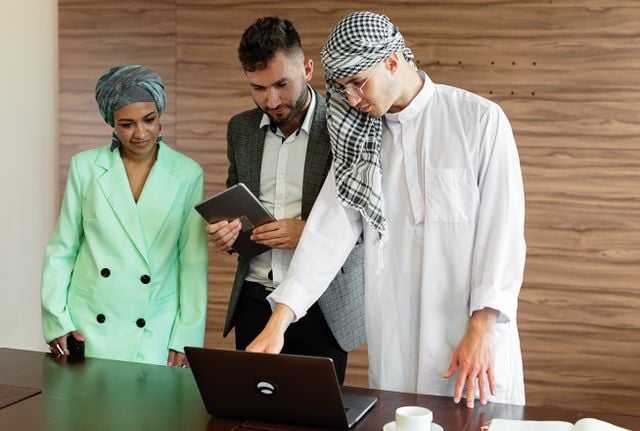
Why Gulf Business Greetings Can Be Longer Than Expected
Professionals who are accustomed to brief workplace greetings may be surprised by the length of some exchanges in the Gulf. Depending on the relationship and setting, a conversation may include several greetings, questions about wellbeing, and expressions of welcome before anyone begins discussing work.
These exchanges can help establish warmth and maintain professional relationships. When someone asks how you’re doing, or enquires about your family, they may be showing consideration and interest in your wellbeing. The purpose and expected level of detail depend on the relationship between the speakers and the situation.
I encourage learners to become comfortable with these conversations because they may encounter them during business visits, introductions, networking events, and informal discussions with colleagues. Understanding a few common questions and responses can help newcomers participate naturally rather than feel unsure about when to move on to the meeting agenda.
A typical exchange might begin with السلام عليكم (as-salāmu ʿalaykum), followed by the conventional response. One person may then ask كيف حالك؟ (kayf ḥālak?, “How are you?”), and the other might reply بخير، الحمد لله (bi-khayr, al-ḥamdu lillāh, “I’m well, thank God”).
The conversation might continue with a question about the journey, recent activities, or how things are going at work. In some relationships, enquiries about family may also be appropriate, although learners should take their cues from the other person and avoid assuming that everyone is comfortable discussing personal matters.
I find it useful to explain that the length of a greeting depends on the people involved and the relationship they’re developing. Some colleagues may exchange only a few words before beginning a meeting, while others prefer a longer conversation. International workplaces may also have communication habits that differ from those found in more locally oriented organizations.
For my corporate students, I would practise both brief and extended greetings. This helps learners recognize when a conversation is continuing naturally and when it’s appropriate to move towards the professional purpose of the meeting.
Arabic Phrases for Asking About Someone’s Wellbeing
Questions about wellbeing are a common part of Arabic greetings, and they’re particularly useful for professionals who want to take part in conversations with local colleagues and business partners.
I usually introduce the more widely understood expressions first, followed by spoken alternatives that learners may encounter in their destination. The choice of phrase can depend on the speaker’s region, the relationship between the people involved, and the level of formality appropriate to the situation.
Here are several expressions worth recognizing:
| Arabic | Pronunciation | English meaning |
| كيف حالك؟ | Kayfa ḥāluka? / Kayfa ḥāluki? | How are you? (formal standard forms addressed to a man or woman) |
| شلونك؟ | Shlōnak? | How are you? (spoken form addressed to a man, used in several Gulf varieties) |
| كيف الحال؟ | Kayf al-ḥāl? | How are things? |
| بخير، الحمد لله | Bi-khayr, al-ḥamdu lillāh | I’m well, thank God |
| الحمد لله | Al-ḥamdu lillāh | Thank God / Praise be to God |
| وأنت؟ | Wa-anta? / Wa-anti? | And you? (addressed to a man or woman) |
| كل شيء تمام | Kull shayʾ tamām | Everything is fine |
The expression كيف حالك؟ (kayfa ḥāluka?) is a useful starting point because it’s broadly understood. In Modern Standard Arabic, the ending changes depending on whether you’re addressing a man or a woman. In everyday speech, learners are likely to hear local pronunciations and different expressions for the same question.
In several Gulf varieties, شلونك؟ (shlōnak?) is a familiar conversational alternative. I’d introduce it to students preparing to work in places where it’s commonly used, while also explaining that Arabic speakers in other parts of the Gulf may prefer different forms.
One response I particularly like to teach is الحمد لله (al-ḥamdu lillāh), literally “Praise be to God.” It’s frequently used when answering questions about wellbeing and can express gratitude or contentment with one’s circumstances. Its meaning and tone depend on the conversation, so students benefit from hearing it in different situations.
An exchange might sound like this:
Person A: كيف حالك؟ Kayfa ḥāluka? How are you?
Person B: بخير، الحمد لله. وأنت؟ Bi-khayr, al-ḥamdu lillāh. Wa-anta? I’m well, thank God. And you?
Person A: الحمد لله، بخير. Al-ḥamdu lillāh, bi-khayr. Thank God, I’m well.
I would practise this kind of conversation with students until they feel comfortable recognizing the questions and responding without having to translate every word mentally. We could then introduce local variants and slightly longer exchanges, allowing them to become familiar with the ways Arabic speakers naturally ask about one another.
For professionals preparing to work in the Gulf, understanding these expressions can make greetings feel much more natural. They provide a foundation for everyday conversations and help learners participate comfortably in the small exchanges that often accompany professional relationships.
Other Arabic Expressions Used in Professional Conversations
Alongside greetings and introductions, several Arabic expressions appear regularly in professional conversations across the Gulf. Some communicate gratitude or appreciation, while others acknowledge someone’s efforts or respond warmly to positive news.
These expressions are particularly interesting because their social meaning often extends beyond their literal translation. The same phrase may sound natural in several different situations, and understanding how colleagues use it can help learners interpret conversations more accurately.
Three expressions worth becoming familiar with are الحمد لله (al-ḥamdu lillāh), ما شاء الله (mā shāʾ Allāh), and يعطيك العافية (yaʿṭīk al-ʿāfiya).
| Arabic | Pronunciation | Literal meaning | Common conversational use |
| الحمد لله | Al-ḥamdu lillāh | Praise be to God | Expressing gratitude, relief, or contentment |
| ما شاء الله | Mā shāʾ Allāh | What God has willed | Expressing admiration or appreciation |
| يعطيك العافية | Yaʿṭīk al-ʿāfiya | May God give you health and strength | Thanking someone or acknowledging their effort |
الحمد لله (al-ḥamdu lillāh) frequently appears in responses to questions about wellbeing, but it can also communicate relief or gratitude after a positive outcome. Imagine a colleague telling you that a difficult project has finally been completed. You might hear al-ḥamdu lillāh as a response expressing appreciation that everything has gone well.
It can also accompany a fuller statement, such as:
الحمد لله، الأمور تسير بشكل جيد.
Al-ḥamdu lillāh, al-umūr tasīr bi-shakl jayyid.
“Thank God, things are going well.”
ما شاء الله (mā shāʾ Allāh) is commonly used when responding to something admirable or positive. A colleague might use it after hearing about a promotion, a successful presentation, or an impressive achievement.
A possible response to positive professional news would be:
ما شاء الله، هذا إنجاز رائع!
Mā shāʾ Allāh, hādhā injāz rāʾiʿ!
“That’s wonderful! What a great achievement!”
The expression communicates admiration and appreciation, although its precise meaning can depend on the speaker’s beliefs, tone, and cultural background. Its use is best understood through conversations in which someone is celebrating an achievement or responding positively to good news.
Another expression worth learning is يعطيك العافية (yaʿṭīk al-ʿāfiya), used in several spoken Arabic varieties, including Gulf contexts. It can acknowledge someone’s work, thank them for their efforts, or express goodwill. You might hear it when someone has completed a task, provided assistance, or finished a busy working day.
Its use and possible responses vary regionally. A professional working in Kuwait may hear it in somewhat different conversational patterns from someone interacting with colleagues in another Gulf country, so destination-specific listening practice can be particularly useful.
These expressions also have religious and cultural significance for many speakers. Their everyday use is widespread, but their meaning should be understood within the circumstances in which they appear. Listening to how colleagues respond to good news, express relief, or acknowledge one another’s efforts provides a useful foundation before incorporating these phrases into your own conversations.
How Arabic Politeness Works in Business Requests
Making requests is an essential part of professional communication, whether you’re asking a colleague for a document, requesting information from a client, or arranging a meeting with a business partner.
In Arabic, the tone of a request can be influenced by the relationship between the speakers, the wording used, and the expressions that accompany it. A greeting, a polite request formula, or a brief expression of appreciation can help establish an appropriate tone.
The relationship between the speakers is an important consideration when choosing how to phrase a request. A colleague you’ve worked with for several years may be comfortable with relatively direct language, while a first meeting with a senior business contact may call for greater formality.
Consider a simple request for a document. In a familiar workplace conversation, someone might say:
ممكن ترسل لي التقرير؟
Mumkin tirsil lī at-taqrīr?
“Could you send me the report?”
This is a useful conversational structure in several spoken Arabic varieties, although the precise pronunciation and wording may differ by region.
For a more formal exchange, a learner might use:
هل يمكنك إرسال التقرير، من فضلك؟
Hal yumkinuka irsāl at-taqrīr, min faḍlik?
“Could you send the report, please?”
The second example uses a more formal sentence structure and an explicit courtesy expression. Both can be appropriate, depending on the context and the people involved.
Practising requests as complete workplace exchanges is especially effective for developing natural communication. A typical exercise might begin with a greeting, followed by the request, the other person’s response, and a brief expression of appreciation or confirmation of the next step. This gives learners experience choosing appropriate expressions while also strengthening their listening comprehension.
Polite Arabic Phrases for Asking for Help
If you’re beginning to use Arabic in a professional environment, learning a few flexible request expressions can make everyday interactions easier.
A useful starting point is a small collection of phrases that can be adapted to different tasks, such as asking for information, requesting assistance, or confirming an arrangement. Regional alternatives and more formal structures can then be introduced according to the learner’s responsibilities and professional environment.
| Arabic | Pronunciation | English meaning |
| لو سمحت | Law samaḥt | Please / If you would |
| من فضلك | Min faḍlik | Please |
| ممكن…؟ | Mumkin…? | Is it possible…? / Could I…? |
| أحتاج إلى… | Aḥtāju ilā… | I need… |
| هل يمكنك مساعدتي؟ | Hal yumkinuka musāʿadatī? | Could you help me? |
| هل يمكننا تأكيد الموعد؟ | Hal yumkinunā taʾkīd al-mawʿid? | Can we confirm the appointment? |
| هل يمكنك توضيح ذلك؟ | Hal yumkinuka tawḍīḥ dhālik? | Could you clarify that? |
One particularly useful expression is لو سمحت (law samaḥt), which is widely used when making polite requests or attracting someone’s attention. Its form changes according to whom you’re addressing, and spoken pronunciation also varies between dialects.
The masculine singular form is a practical starting point, but learners should also become familiar with how the expression changes when addressing a woman or a group.
Another valuable expression is ممكن (mumkin), meaning “possible.” It can introduce requests in many everyday conversations, making it useful for asking about assistance, information, or arrangements.
من فضلك (min faḍlik) is another widely understood way of saying “please.” The pronunciation and grammatical form depend on the addressee, while local spoken alternatives may be more common in certain Gulf settings.
For professionals who regularly attend meetings, requests for clarification deserve particular attention. Understanding how to ask someone to repeat, explain, or confirm information can prevent misunderstandings and help learners participate confidently even when their vocabulary is limited.
These phrases are well suited to activities involving realistic workplace tasks. A student might ask a colleague for a document, request an explanation of an unfamiliar procedure, or confirm the time of a meeting. Repeating the interaction with different responses allows learners to develop greater flexibility and become more comfortable adapting their language.
How to Say Thank You in Arabic Business Settings
Expressing gratitude is one of the most useful communication skills for professionals learning Arabic. You’ll have opportunities to thank colleagues, clients, hosts, and service providers throughout the working day, and a few familiar expressions can help you respond appropriately.
The most common starting point is شكراً (shukran), meaning “Thank you.” It’s widely understood across Arabic-speaking countries and can be used in many professional and everyday situations.
For stronger appreciation, you can say شكراً جزيلاً (shukran jazīlan), meaning “Thank you very much.” Both expressions are useful for beginners because they’re easy to incorporate into familiar exchanges.
Other useful phrases include:
| Arabic | Pronunciation | English meaning |
| شكراً | Shukran | Thank you |
| شكراً جزيلاً | Shukran jazīlan | Thank you very much |
| العفو | Al-ʿafw | You’re welcome |
| أشكرك على مساعدتك | Ashkuruka ʿalā musāʿadatik | Thank you for your help (addressing a man) |
| أقدّر مساعدتك | Uqaddir musāʿadataka | I appreciate your help (addressing a man) |
| يعطيك العافية | Yaʿṭīk al-ʿāfiya | An expression of appreciation for someone’s effort |
العفو (al-ʿafw) is worth learning alongside shukran because it’s a common response to thanks. Recognizing this expression allows learners to follow a simple exchange from beginning to end.
In professional relationships, appreciation can also be expressed through longer phrases, particularly when someone has provided substantial assistance or welcomed you as a guest. The appropriate degree of formality depends on the relationship, and observing how colleagues thank one another can help learners choose expressions that sound natural.
After a routine business meeting, a simple shukran may be entirely appropriate. If a client has hosted a visit or helped arrange an important introduction, a more elaborate expression of appreciation may be suitable. Practising these situations helps learners distinguish between everyday politeness and expressions that communicate stronger gratitude.
Hospitality Language in Gulf Business Culture
Hospitality can play an important role in professional relationships across the Gulf, particularly when welcoming visitors, hosting meetings, or receiving business partners.
Depending on the setting, a meeting may begin with an offer of coffee, tea, or other refreshments. These gestures can help create a welcoming atmosphere and provide an opportunity for informal conversation before moving into business matters.
For professionals unfamiliar with the region, understanding how Arabic expressions accompany these interactions can make business visits feel more comfortable. Recognizing a welcoming phrase, responding to an offer, and thanking a host are useful skills when participating in the social side of a professional meeting.
One expression that deserves early attention is تفضل (tafaḍḍal), which appears in many different situations. Depending on the context, it can invite someone to enter a room, proceed with an activity, accept something, or help themselves to refreshments.
Imagine arriving at a client’s office and being invited into a meeting room. The host may say tafaḍḍal while gesturing towards the doorway or an available seat. Later, the same expression might accompany an offer of coffee.
Paying attention to the words, gestures, and situation together makes the intended meaning easier to understand, especially when a familiar expression serves several purposes.
Hospitality practices vary between Gulf countries and individual workplaces. A traditional business gathering may involve different customs from a short meeting in an international corporate office, and personal preferences also influence what hosts offer and how guests respond.
Realistic hospitality scenarios provide valuable preparation for these interactions. By practising how to respond to invitations, accept refreshments, and show appreciation, learners can become more comfortable participating in professional social exchanges.
Arabic Phrases for Offering and Accepting Hospitality
When learning Arabic hospitality expressions, it’s useful to begin with the phrases you’re most likely to hear when entering a meeting or being offered refreshments.
تفضل (tafaḍḍal) is especially versatile, making it a practical starting point. Its precise meaning becomes clearer when you consider what the speaker is doing and what they’re inviting the other person to do.
Here are some expressions worth learning:
| Arabic | Pronunciation | English meaning |
| تفضل | Tafaḍḍal | Please / Go ahead / Help yourself (to a man) |
| تفضلي | Tafaḍḍalī | Please / Go ahead / Help yourself (to a woman) |
| هل تريد قهوة؟ | Hal turīd qahwa? | Would you like coffee? (to a man) |
| نعم، شكراً | Naʿam, shukran | Yes, thank you |
| بكل سرور | Bi-kull surūr | With pleasure |
| شكراً على الضيافة | Shukran ʿalā aḍ-ḍiyāfa | Thank you for the hospitality |
| أهلاً وسهلاً | Ahlan wa-sahlan | Welcome |
A useful practice scenario involves a host offering coffee to a visitor:
Host: تفضل، قهوة؟ Tafaḍḍal, qahwa? “Please, would you like some coffee?”
Visitor: نعم، شكراً. Naʿam, shukran. “Yes, thank you.”
The exchange is short, but it contains several important elements: recognizing an invitation, understanding what is being offered, and responding politely.
The same scenario can be adapted to include different refreshments or an invitation to take a seat. Changing the circumstances helps students become familiar with the different meanings of tafaḍḍal and recognize how the surrounding interaction influences its interpretation.
When studying spoken Gulf Arabic, learners will also benefit from hearing local forms and pronunciations relevant to their destination. This is particularly useful for listening comprehension because hospitality expressions may sound different from the formal Arabic forms commonly presented in textbooks.
How to Politely Decline an Offer in Arabic
Knowing how to decline an offer graciously is just as useful as knowing how to accept one. During business visits, you may be offered coffee, tea, food, or another refreshment when you’ve already eaten or simply don’t want anything.
A practical response is لا، شكراً (lā, shukran), meaning “No, thank you.” This is widely understood and provides a polite starting point for beginners.
You could also use a fuller expression such as:
لا، شكراً جزيلاً.
Lā, shukran jazīlan.
“No, thank you very much.”
The tone of the response and the surrounding conversation can help communicate appreciation for the offer. Thanking the host acknowledges the gesture even when you’re declining the refreshment.
In some hospitality settings, the host may repeat an invitation or encourage a guest to accept something. This can be part of a warm and welcoming interaction, but practices vary according to the individuals and circumstances.
Paying attention to the host’s cues is therefore valuable when deciding how to respond. A polite refusal is often perfectly acceptable, particularly when expressed with appreciation, and there’s no need to assume that every repeated offer carries the same expectation.
A useful classroom activity involves practising the same hospitality exchange with several variations. The learner might accept the first offer, decline politely, or thank the host after an additional invitation. These exercises build confidence in situations where the vocabulary is relatively simple but the interaction requires awareness of the relationship between the speakers.
How to Agree, Disagree, and Clarify Politely in Arabic
Professional conversations require more than exchanging greetings and making requests. Employees and business partners also need to express agreement, discuss different opinions, and confirm that they’ve understood important information.
These situations can be challenging for learners because the appropriate level of directness depends on several factors, including the relationship between speakers, the subject being discussed, and the communication style of the workplace.
Arabic offers various ways to agree or disagree, ranging from brief conversational expressions to more formal statements. A useful starting point is to learn how to acknowledge another person’s point before introducing a different perspective.
Here are some expressions that can help:
| Arabic | Pronunciation | English meaning |
| نعم، أتفق معك | Naʿam, attafiq maʿak | Yes, I agree with you |
| هذا صحيح | Hādhā ṣaḥīḥ | That’s correct |
| أفهم وجهة نظرك | Afham wijhat naẓarik | I understand your point of view |
| لدي رأي مختلف | Ladayya raʾy mukhtalif | I have a different opinion |
| هل يمكنك توضيح ذلك؟ | Hal yumkinuka tawḍīḥ dhālik? | Could you clarify that? |
| هل يمكن أن تعيد ذلك؟ | Hal yumkin an tuʿīd dhālik? | Could you repeat that? |
| هل فهمت بشكل صحيح؟ | Hal fahimtu bi-shakl ṣaḥīḥ? | Have I understood correctly? |
Several of these expressions are presented in Modern Standard Arabic and are useful as broadly understandable models. In spontaneous workplace conversations, local speakers may use shorter or more idiomatic alternatives. Some forms also change according to the gender or number of people being addressed.
A phrase such as أفهم وجهة نظرك (afham wijhat naẓarik), meaning “I understand your point of view,” can be useful when introducing a different perspective. It acknowledges what the other person has said before the speaker presents an alternative.
For example, imagine discussing a proposed project schedule with a colleague. You understand their suggestion, but you believe the timeline may be difficult to meet. Rather than simply rejecting the proposal, you can acknowledge their perspective and explain your concern.
That doesn’t mean Arabic speakers always avoid direct disagreement. Communication styles vary considerably, and a straightforward response may be entirely appropriate between familiar colleagues or during technical discussions. The important skill is recognizing which level of formality and directness suits the particular conversation.
Clarification is especially valuable in professional environments where misunderstandings can affect deadlines, responsibilities, or project outcomes. Asking someone to explain a point again is preferable to proceeding with information you haven’t fully understood.
One activity I use with corporate learners involves discussing a proposed meeting time or project deadline. The student must listen to a suggestion, agree or offer a different option, and confirm the final arrangement. The exercise combines several communication skills while keeping the vocabulary relevant to the learner’s actual responsibilities.
Arabic Phrases for Scheduling and Following Up on Meetings
Arranging meetings, discussing deadlines, and following up on tasks are common responsibilities in professional environments. Even when most workplace communication takes place in English, understanding a few Arabic expressions related to scheduling can be helpful when interacting with local colleagues and business partners.
For beginners, the most useful phrases are those that help establish dates and times, confirm arrangements, and ask for updates. These expressions can be practised through short conversations before introducing more complex workplace vocabulary.
| Arabic | Pronunciation | English meaning |
| متى سيكون الاجتماع؟ | Matā sayakūnu al-ijtimāʿ? | When will the meeting be? |
| في أي ساعة يبدأ الاجتماع؟ | Fī ayyi sāʿa yabdaʾ al-ijtimāʿ? | What time does the meeting start? |
| هل يمكننا تأكيد الموعد؟ | Hal yumkinunā taʾkīd al-mawʿid? | Can we confirm the appointment? |
| هل يناسبك يوم الأحد؟ | Hal yunāsibuka yawm al-aḥad? | Does Sunday work for you? |
| هل يمكننا تأجيل الاجتماع؟ | Hal yumkinunā taʾjīl al-ijtimāʿ? | Can we postpone the meeting? |
| متى سيكون التقرير جاهزاً؟ | Matā sayakūnu at-taqrīr jāhizan? | When will the report be ready? |
| هل هناك أي تحديثات؟ | Hal hunāka ayyu taḥdīthāt? | Are there any updates? |
| سأرسل لك التفاصيل | Saʾursilu laka at-tafāṣīl | I’ll send you the details |
These expressions use standard Arabic structures, and several are more formal than the alternatives speakers might choose in casual office conversations. Nevertheless, they introduce useful vocabulary related to meetings, dates, reports, and follow-up communication.
The phrase هل يمكننا تأكيد الموعد؟ (hal yumkinunā taʾkīd al-mawʿid?) is particularly useful because it allows you to confirm an arrangement without sounding confrontational. It’s appropriate when the details of a meeting or appointment need to be established clearly.
Another practical expression is هل هناك أي تحديثات؟ (hal hunāka ayyu taḥdīthāt?), meaning “Are there any updates?” This provides a straightforward way to ask about progress on a task or project.
When discussing future arrangements, learners may also encounter إن شاء الله (in shāʾ Allāh). As we’ve seen, its presence doesn’t automatically establish whether a deadline or appointment has been firmly confirmed. The surrounding conversation provides the information needed to interpret the speaker’s intention.
For that reason, I encourage students to develop the habit of confirming important details politely. If a colleague expresses the intention to complete a task, it can be useful to establish the expected date, the person responsible, and any necessary follow-up.
Role-play exercises work particularly well for scheduling. One student might propose a meeting time, while the other explains that they’re unavailable and suggests an alternative. The conversation can then continue until both participants have confirmed an arrangement.
These activities help learners practise useful vocabulary while developing the ability to negotiate practical details respectfully and clearly.
Arabic for Business Meetings and Negotiations
Arabic can play several different roles during business meetings in the Gulf. In some workplaces, discussions may take place almost entirely in English, with Arabic used mainly for greetings and informal exchanges. In others, participants may use Arabic throughout the meeting, particularly when communicating with local colleagues or clients.
For professionals who are just beginning to learn the language, the first objective should be understanding and participating in familiar parts of these interactions. Greeting participants, introducing yourself, responding to a polite request, and asking for clarification are all manageable goals that provide practical value.
Listening comprehension is especially important. A learner who recognizes common meeting expressions and understands when someone is asking a question or requesting confirmation can participate more confidently, even if they’re not yet able to express complex ideas in Arabic.
Formal negotiations require a considerably more advanced level of language proficiency. Discussing contractual obligations, evaluating proposals, presenting technical arguments, or negotiating financial terms involves specialized vocabulary and the ability to interpret subtle differences in meaning.
Memorizing a collection of Arabic business phrases cannot replace the language skills required for these responsibilities. A professional who needs to negotiate complex agreements in Arabic should receive training appropriate to that level of communication and use qualified language support when necessary.
For beginners, I prefer concentrating on a manageable set of practical tasks. A useful lesson might involve arriving at a meeting, greeting the participants, introducing yourself, and confirming the purpose of the discussion. As the learner progresses, additional activities can include asking questions, requesting clarification, and summarizing the next steps.
The choice of language also depends on the learner’s professional role. Someone working in sales may need to build familiarity with client-facing expressions and product terminology, while a project manager may benefit from vocabulary related to schedules, responsibilities, and progress updates.
In either case, developing cultural awareness alongside language skills helps professionals understand how greetings, forms of address, and conversational courtesies contribute to the meeting as a whole. These abilities provide a useful foundation for more advanced business Arabic studies.
Business Arabic Differences Across Gulf Countries
Although Arabic is widely spoken throughout the Gulf, it’s important to recognize that there is no single spoken variety used identically across the region. The Arabic heard in the UAE, Saudi Arabia, Qatar, Kuwait, Bahrain, and Oman includes distinctive vocabulary, pronunciation patterns, and grammatical features.
Many common greetings and courtesy expressions are understood across national boundaries, but everyday speech can vary considerably. A learner who studies one variety of Gulf Arabic may recognize much of what people say in a neighbouring country while still encountering unfamiliar words or expressions.
Regional differences also exist within individual countries. Saudi Arabia, for example, has several major spoken varieties, including those associated with Najd, the Hijaz, and the Eastern Province. Bahrain and Oman also have significant internal linguistic diversity, making it difficult to represent either country through a single set of conversational expressions.
These differences matter when professionals expect to communicate regularly with local colleagues or clients. Someone preparing for a position in Riyadh may benefit from different listening materials and spoken vocabulary from a learner relocating to Kuwait City or Muscat.
The language used in professional settings also depends on the workplace. An international technology company may operate mainly in English, while a local business or government organization may use Arabic more frequently. Even within the same company, formal written communication may use Modern Standard Arabic while everyday conversations involve local spoken varieties.
When planning lessons for corporate students, I begin by identifying their destination, industry, and expected professional contacts. This helps determine whether to prioritize formal reading skills, broadly understood courtesy expressions, or the local spoken Arabic they’ll encounter most often.
A beginner preparing for a short business trip may only need greetings, introductions, expressions of appreciation, and a few questions. Someone relocating for a long-term assignment with regular client contact would benefit from more extensive listening and conversational practice.
The most effective preparation combines useful shared expressions with attention to the language actually spoken in the learner’s professional environment.
Business Arabic for the UAE, Saudi Arabia, and Qatar
Dubai, Riyadh, and Doha are important destinations for international business professionals, but the language priorities of someone relocating to each city may differ.
While these destinations share many familiar Arabic expressions, their local spoken varieties and professional environments are not identical. The most appropriate course content depends on the people the learner expects to communicate with and how frequently Arabic will be used during the working day.
| Destination | Arabic learning priorities | Practical workplace situations |
| Dubai, UAE | Widely understood courtesies, Emirati expressions, and listening practice suited to international workplaces | Greeting local clients, introducing colleagues, participating in informal conversations |
| Riyadh, Saudi Arabia | Saudi spoken Arabic relevant to the learner’s contacts, respectful forms of address, and professional requests | Meeting colleagues, discussing schedules, confirming responsibilities, communicating with local partners |
| Doha, Qatar | Shared Gulf courtesy expressions, Qatari listening practice, and language for professional relationships | Welcoming clients, making introductions, responding to hospitality, arranging meetings |
In Dubai, many professionals work in highly international environments where English is commonly used for meetings and written communication. Arabic still plays an important role in local relationships, and learners who interact frequently with Emirati colleagues or clients can benefit from becoming familiar with Emirati greetings and conversational expressions.
One distinctive expression is مرحبا الساع (marḥaba as-sāʿ), a welcoming phrase associated with Emirati Arabic. It’s useful to recognize when meeting local speakers, although beginners can initially rely on widely understood expressions such as as-salāmu ʿalaykum and marḥaban.
For someone relocating to Dubai, I would begin with these common courtesies before introducing Emirati listening activities and expressions relevant to the learner’s professional interactions.
In Riyadh, the focus may shift towards Saudi spoken Arabic and the communication patterns of the learner’s particular workplace. Saudi Arabia has substantial regional variation, so a course designed for someone working in the capital may differ from one intended for professionals based in Jeddah or the Eastern Province.
Greetings, respectful forms of address, polite requests, and clarification strategies are valuable priorities. Learners who regularly interact with local colleagues can gradually build their understanding of the vocabulary and pronunciation patterns they’re most likely to encounter.
In Doha, widely understood Arabic courtesies provide a useful starting point, particularly for professionals working in international companies. Qatari Arabic can then be introduced through listening exercises, workplace conversations, and expressions relevant to meetings and client relationships.
Qatari Arabic shares features with neighbouring Gulf varieties, but it also has distinctive characteristics. Learning to recognize local pronunciation and conversational habits can help professionals follow informal interactions more comfortably.
Other Gulf destinations deserve similarly specific preparation.
In Kuwait, learning commonly used expressions such as شلونك (shlōnak, “How are you?”) and شنو (shinu, “What?”) can be valuable for professionals who regularly speak with local colleagues. These forms are particularly useful for understanding everyday conversations.
In Bahrain, learners benefit from widely understood courtesies alongside listening practice tailored to the Bahraini varieties used by their professional contacts. The country’s spoken Arabic includes meaningful internal variation, so local examples should reflect the individuals and communities with whom the learner expects to interact.
In Oman, locally appropriate listening materials are especially important because Omani Arabic encompasses several varieties that differ from those commonly featured in general Gulf Arabic courses. Someone relocating to Muscat for regular interaction with Omani colleagues would benefit from learning expressions and pronunciation patterns relevant to that environment.
Across all these destinations, the guiding principle remains the same: learn the Arabic you’re most likely to use and hear. Starting with shared greetings and courtesies gives professionals an accessible foundation, while destination-specific practice helps them develop the language skills needed for more natural communication with colleagues and business partners.

Common Arabic Business Etiquette Mistakes
Learning Arabic business phrases is an excellent starting point, but using them appropriately requires some understanding of the relationships and situations in which they appear. An expression that sounds perfectly natural between familiar colleagues may feel too informal during a first meeting with a senior client. Similarly, a phrase that works well in one Gulf country may be less common in another.
From my experience teaching Arabic to adult learners, the most important mistakes to address are those that affect the meaning of a conversation or create unnecessary misunderstandings. These are some of the issues professionals should pay particular attention to:
- Rushing through greetings. Moving immediately into a request or business discussion can sometimes feel abrupt, particularly when the other person expects a more extended greeting. Take time to acknowledge your colleague or client, exchange a few pleasantries when appropriate, and follow their lead before moving towards the agenda.
- Learning greetings without their responses. Knowing how to say السلام عليكم (as-salāmu ʿalaykum) is useful, but you should also recognize وعليكم السلام (wa-ʿalaykum as-salām) and understand how the conversation might continue. Practising complete exchanges prepares you to participate naturally when someone responds or asks a follow-up question.
- Using expressions that are too familiar or overly formal. Some phrases are common in relaxed conversations between friends or colleagues but may sound out of place in a formal business meeting. Conversely, using elaborate Modern Standard Arabic expressions during an informal exchange can sound unnecessarily stiff. Pay attention to the relationship between speakers and the language used in your workplace.
- Misinterpreting in shāʾ Allāh. Assuming that إن شاء الله always confirms a commitment, expresses uncertainty, or indicates a refusal can lead to misunderstandings. Consider the surrounding conversation and clarify important dates, responsibilities, or arrangements when necessary.
- Translating English requests word for word. A grammatically understandable translation may not always communicate the intended level of politeness. Learning expressions such as لو سمحت (law samaḥt) and ممكن (mumkin) can help you make requests in ways that suit the conversational setting.
- Treating all Gulf Arabic varieties as identical. An expression commonly used in Kuwait may not be the most natural choice in Oman or the UAE. Begin with widely understood courtesies, then develop familiarity with the spoken Arabic used by your colleagues and business contacts.
- Making assumptions about hospitality. An invitation to have coffee or tea may be part of welcoming a visitor and establishing rapport. At the same time, accepting every offer is not necessarily expected. Recognize the gesture, express appreciation, and respond according to the circumstances and the host’s cues.
It’s also important to distinguish these communication difficulties from minor language mistakes. A beginner may mispronounce a word, use an imperfect grammatical structure, or hesitate while choosing an expression. These are normal parts of learning, and they generally deserve less immediate attention than errors that change the intended meaning or affect the interaction.
When working with corporate learners, I prioritize clear communication, appropriate expressions, and the ability to respond to others. Pronunciation and grammar remain important, but learners make more meaningful progress when they can successfully complete a conversation and gradually refine their language skills through practice.
A Practical Business Arabic Lesson for Gulf Relocation
For an English-speaking professional preparing to relocate to Dubai, Riyadh, or Doha, the first few Arabic lessons should concentrate on communication tasks they’ll encounter soon after arrival. Greetings, introductions, hospitality, and polite requests provide an accessible foundation, especially for learners whose main working language will remain English.
I would organize the first three lessons around practical outcomes. Each session would introduce a manageable number of expressions, provide opportunities to hear them in context, and finish with a role-play that requires the learner to communicate without reading from a script.
The exact vocabulary and spoken forms would be adapted to the student’s destination, but the overall progression would remain similar.
Lesson 1: First Impressions and Professional Introductions
Suggested duration: 45–60 minutes
The first lesson would focus on greeting colleagues and clients, responding appropriately, and introducing basic professional information. By the end of the session, the learner should be able to enter a workplace, exchange greetings, and explain who they are and where they work.
We would begin with expressions such as:
| Arabic | Pronunciation | English meaning |
| السلام عليكم | As-salāmu ʿalaykum | Peace be upon you |
| وعليكم السلام | Wa-ʿalaykum as-salām | And peace be upon you |
| صباح الخير | Ṣabāḥ al-khayr | Good morning |
| صباح النور | Ṣabāḥ an-nūr | A conventional response to good morning |
| اسمي… | Ismī… | My name is… |
| أنا أعمل في… | Anā aʿmal fī… | I work at/in… |
| تشرّفنا | Tasharrafnā | Pleased to meet you |
After practising pronunciation and listening to short exchanges, the student would complete a role-play based on arriving at a new office.
Role-play: Your first day at work
The student enters a simulated office and meets a colleague.
Colleague: السلام عليكم. As-salāmu ʿalaykum. “Peace be upon you.”
Learner: وعليكم السلام. اسمي سارة. Wa-ʿalaykum as-salām. Ismī Sāra. “And peace be upon you. My name is Sarah.”
Colleague: أهلاً وسهلاً يا سارة. Ahlan wa-sahlan yā Sāra. “Welcome, Sarah.”
Learner: شكراً. أنا أعمل في قسم التسويق. Shukran. Anā aʿmal fī qism at-taswīq. “Thank you. I work in the marketing department.”
The same activity can then be repeated with different circumstances. The learner might meet a client for the first time, introduce themselves to a group of colleagues, or respond to an unexpected question about their position.
The main priorities for correction would be recognizing and responding to greetings, choosing appropriate expressions, and communicating basic information clearly.
Lesson 2: Building Rapport Through Titles, Hospitality, and Small Talk
Suggested duration: 45–60 minutes
The second lesson would introduce respectful forms of address, brief conversations before meetings, and common hospitality expressions. These skills are useful when welcoming visitors, meeting senior colleagues, or attending a business gathering.
I would begin with expressions such as أستاذ (ustādh), أستاذة (ustādha), تفضل (tafaḍḍal), شكراً جزيلاً (shukran jazīlan), and نعم، شكراً (naʿam, shukran). Learners would also practise a few simple questions about wellbeing and become familiar with expressions such as الحمد لله (al-ḥamdu lillāh).
Role-play: Meeting a senior colleague and accepting hospitality
The learner arrives for a meeting with a senior colleague. After exchanging greetings, the host offers coffee.
Host: أهلاً وسهلاً. تفضل، قهوة؟ Ahlan wa-sahlan. Tafaḍḍal, qahwa? “Welcome. Please, would you like some coffee?”
Learner: نعم، شكراً جزيلاً. Naʿam, shukran jazīlan. “Yes, thank you very much.”
Host: كيف حالك؟ Kayfa ḥāluk? “How are you?”
Learner: بخير، الحمد لله. وأنت؟ Bi-khayr, al-ḥamdu lillāh. Wa-anta? “I’m well, thank God. And you?”
After the initial exchange, the learner would practise transitioning towards the purpose of the meeting.
We could then repeat the scenario with a different host who offers tea instead of coffee or with a visitor who prefers to decline refreshments. Additional variations might involve greeting someone using their professional title or responding to a longer welcoming conversation.
The aim would be to help learners recognize how language, gestures, and conversational expectations work together. Particular attention would be given to respectful forms of address, appropriate responses to hospitality, and the ability to continue a brief conversation naturally.
Lesson 3: Making Polite Requests and Confirming Arrangements
Suggested duration: 45–60 minutes
The third lesson would concentrate on communication tasks such as requesting information, asking for assistance, discussing deadlines, and confirming meeting arrangements.
These situations are especially valuable for corporate learners because they connect Arabic expressions to practical workplace responsibilities. Students can begin with familiar phrases and gradually learn to combine them into longer requests.
Useful expressions include:
| Arabic | Pronunciation | English meaning |
| لو سمحت | Law samaḥt | Please / If you would |
| ممكن…؟ | Mumkin…? | Is it possible…? |
| أحتاج إلى… | Aḥtāju ilā… | I need… |
| هل يمكنك مساعدتي؟ | Hal yumkinuka musāʿadatī? | Could you help me? |
| متى سيكون الاجتماع؟ | Matā sayakūnu al-ijtimāʿ? | When will the meeting be? |
| هل يمكننا تأكيد الموعد؟ | Hal yumkinunā taʾkīd al-mawʿid? | Can we confirm the appointment? |
| إن شاء الله | In shāʾ Allāh | God willing |
Role-play: Requesting a report and confirming a deadline
The learner needs a report from a colleague before an upcoming meeting.
Learner: لو سمحت، هل يمكنك إرسال التقرير غداً؟ Law samaḥt, hal yumkinuka irsāl at-taqrīr ghadan? “Could you please send the report tomorrow?”
Colleague: إن شاء الله. In shāʾ Allāh. “God willing.”
Learner: هل يمكننا تأكيد أن التقرير سيكون جاهزاً غداً؟ Hal yumkinunā taʾkīd anna at-taqrīra sayakūnu jāhizan ghadan? “Can we confirm that the report will be ready tomorrow?”
This exchange provides an opportunity to practise a polite request and an appropriate follow-up question. The learner must recognize that in shāʾ Allāh can communicate different intentions depending on context and that confirming an important deadline may require additional information.
The activity could then be adapted to involve arranging a meeting, requesting a document from a senior colleague, or discussing a deadline with a client.
At this stage, the main focus would be choosing expressions that suit the relationship, communicating clearly, and confirming practical details without making assumptions.
Adapting Business Arabic Lessons to Dubai, Riyadh, and Doha
The three lessons provide a useful starting framework, but the language and listening materials should reflect the learner’s destination.
For someone moving to Dubai, I would emphasize widely understood courtesy expressions and introduce Emirati listening samples where relevant. Professional role-plays could reflect the international nature of many workplaces, including situations where a conversation begins in Arabic before continuing in English.
For Riyadh, lessons would incorporate Saudi spoken Arabic appropriate to the learner’s professional contacts. Particular attention could be given to forms of address, workplace greetings, and the language used to clarify arrangements or responsibilities.
For Doha, broadly understood expressions would provide the initial foundation, followed by Qatari spoken patterns relevant to the learner’s workplace. Listening exercises and role-plays could involve greeting local clients, responding to hospitality, and confirming meeting details.
At the end of the three lessons, I would bring these skills together in one extended simulation. The learner would arrive at a business meeting, greet a colleague, introduce themselves, respond to an offer of coffee, request a document, and confirm a follow-up deadline.
Progress would be assessed through five practical criteria:
- Comprehensibility: Can the learner communicate their intended message clearly?
- Appropriate register: Do they choose expressions that suit the relationship and situation?
- Listening and response: Can they recognize common greetings and questions and respond naturally?
- Cultural awareness: Do they understand how titles, hospitality, and courtesy expressions influence the interaction?
- Task completion: Can they obtain the information or confirmation they need?
This approach allows students to see how much they can accomplish with a manageable collection of expressions. It also provides a foundation for future lessons, which can gradually introduce more specialized vocabulary and increasingly complex professional situations.
Learn Business Arabic With a Native Teacher
If you’re preparing to work in Dubai, Riyadh, Doha, or another Gulf destination, learning Arabic with a native teacher can help you concentrate on the communication skills most relevant to your professional responsibilities.
At Language Trainers, business language lessons can be tailored to your existing proficiency, destination, industry, and learning goals. Whether you need to greet local clients, participate in workplace conversations, understand common courtesy expressions, or develop more advanced professional Arabic, a personalized course allows you to focus on the situations you’re most likely to encounter.
Working with a teacher also gives you opportunities to practise realistic conversations and receive immediate feedback. You can learn how expressions change according to formality, become familiar with regional pronunciation, and develop the listening skills needed to understand how colleagues naturally communicate.
As an Arabic teacher, I’ve found that a communicative, task-based approach is particularly valuable for adult professionals. Beginning with common greetings and courtesy expressions gives learners an accessible foundation, while gradually introducing destination-specific language helps them develop confidence in the environments where they’ll actually use Arabic.
Personalized lessons also allow the pace and difficulty to change according to the learner’s progress. This flexibility can be especially important for busy professionals preparing for relocation or balancing language study with demanding work schedules.
Dean Lamb, who recently started taking Arabic lessons in Ottawa, shared his experience:
“First lesson was excellent. The instructor adjusted her teachings to how fast I was learning and knew when to take a step back.”
Building professional relationships in the Gulf begins with understanding the people you’re communicating with. Familiar greetings, appropriate forms of address, hospitality expressions, and courteous requests can help you participate more comfortably in everyday interactions, while the ability to clarify expectations respectfully remains essential for effective business communication.
The most productive starting point is to learn a manageable selection of high-frequency expressions, understand how they’re used in context, and gradually develop the regional language skills your professional environment requires. With regular practice and guidance from a native teacher, these expressions can become a natural part of your workplace conversations.
Planning to work or relocate to the Gulf? Explore personalized Arabic lessons with Language Trainers and prepare for professional conversations with native-speaking teachers who can help you develop practical language skills for your destination, industry, and career goals.
→Sign Up Now: Free Trial Arabic Lesson With a Native Teacher!←
FAQs About Arabic Business Phrases and Gulf Business Etiquette
1. Do You Need to Speak Arabic to Do Business in the Gulf?
You can conduct business in English in many international workplaces across the Gulf, particularly in cities such as Dubai, Doha, and Riyadh. However, learning basic Arabic greetings, courtesy expressions, and polite requests can help you build relationships with local colleagues, clients, and business partners. Even a limited knowledge of Arabic can make professional interactions more comfortable and demonstrate an interest in the language and culture of the people you’re working with.
2. Should You Learn Modern Standard Arabic or Gulf Arabic for Business?
The best choice depends on your professional responsibilities and where you’ll be working. Modern Standard Arabic is useful for formal writing, official documents, and certain professional communications, while regional spoken Arabic is generally more practical for everyday conversations. I recommend starting with widely understood greetings and courtesy expressions before introducing the local variety spoken by your colleagues and clients.
3. What Are the Most Useful Arabic Greetings for Business Meetings?
Some of the most useful greetings include السلام عليكم (as-salāmu ʿalaykum, “Peace be upon you”), صباح الخير (ṣabāḥ al-khayr, “Good morning”), and مرحباً (marḥaban, “Hello”). It’s equally important to recognize common responses, such as وعليكم السلام (wa-ʿalaykum as-salām) and صباح النور (ṣabāḥ an-nūr). Learning these expressions as complete exchanges will help you participate more naturally in professional introductions and conversations.
4. Does In Shāʾ Allāh Mean Someone Has Agreed to a Business Commitment?
إن شاء الله (in shāʾ Allāh, “God willing”) can communicate genuine intention, hope, or uncertainty about a future event, depending on the context. It doesn’t automatically indicate either a confirmed commitment or a polite refusal. When discussing important deadlines or appointments, I recommend asking a respectful follow-up question to confirm the practical details rather than making assumptions about the speaker’s intentions.
5. How Can You Show Respect and Respond to Hospitality in Gulf Business Settings?
Begin with an appropriate greeting, pay attention to professional titles, and acknowledge expressions of welcome or hospitality. If someone offers you coffee or tea, you can accept with نعم، شكراً (naʿam, shukran, “Yes, thank you”) or decline politely with لا، شكراً (lā, shukran, “No, thank you”). Customs vary between countries, workplaces, and individuals, so observing your host’s behaviour and responding with genuine appreciation is generally the best approach.